BUILDING BELONGING

How AFOL Creator and Community Connector Mounir Khoury Found His Voice—And Helped Others Find Theirs
At Blacklug, community has always been more than a concept—it’s built through real connections, shared spaces, and the people you meet along the way.
I first met Mounir Khoury at The Bricks in the Six show in Toronto in 2024. Like many of the most meaningful relationships in this community, it didn’t begin with a formal introduction or a title, but with conversation—about Lego, creativity, culture, and the personal journeys that shape how and why we build.
Since then, it has been a genuine pleasure—and an honour—to not only collaborate with Mounir, but to call him a friend. His work, perspective, and commitment to the LEGO community reflect the values Blacklug stands for: creativity rooted in identity, storytelling with purpose, and a willingness to show up authentically.
The following piece is a reflection of that journey. It speaks to Mounir’s background, his relationship with Lego, and the path that led him to where he is today—not just as a builder, but as a voice within the community. Stories like his are exactly why Blacklug exists.
Because behind every build is a person.And behind every person is a story worth telling.

In the vast universe of Lego fans, where bricks become architecture, characters, galaxies, and entire worlds, some creators stand out not just for what they build—but for why they build. For Lebanese-Canadian AFOL Mounir Khoury, LEGO has become a medium for storytelling, community, and cultural expression in ways he never imagined as a child.
THE DREAM THAT STARTED IN A THRIFT STORE
What first sparked your love for Lego, and how has the connected evolved over the years?
Growing up in Canada after immigrating as an infant from southern Lebanon, LEGO was always just out of reach.
“We had everything we needed,” Mounir recalls, “but LEGO was a luxury item.”Video games filled the gap—Mario, Zelda, anything immersive. But the dream of one day having a LEGO room stayed quietly alive.
That dream resurfaced unexpectedly in 2013. While hunting for toys for his young children, Mounir stumbled on bulk LEGO at a local thrift store. Affordable, overflowing, full of possibility.Piece by piece, the hobby he intended for his kids became a creative journey all his own.
“I realized how much I loved making my own builds. I ended up becoming the AFOL in the family.”

THE LEGO STORE CALLS
You work at a Lego store, what drew you to that role originally?
Retail work was always second nature to Mounir, even alongside a career as a Canadian public servant. So when a Lego Store opened within walking distance of his home—and the staff already knew him as a regular—the opportunity felt almost predestined.
“I couldn’t have asked for a better mix: LEGO and engaging with people.”
In the store, he thrived. Kids eagerly shared their latest creations. Parents sought advice on sorting, themes, or that perfect first set. For many families, Mounir became the bridge between curiosity and creativity.
Do you have a favourite part of your Lego “day job” or hobby? What brings you the most joy?
“Inspiring others never gets old,” he says. “Sometimes a single conversation can unlock a kid’s imagination.”
WHERE IDEAS ARE BORN
When it comes to MOCs, Mounir blends planning with improvisation. Inspiration might come from a minifigure, a rare part, or simply a spark of curiosity.
He often sketches loose outlines or immerses himself in concept art and cinematography to lock in a “feel.” But his process remains, at its core, tactile.
“I rarely build digitally. I need bricks in my hands. I iterate until it feels right.”
This hands-on approach gives his work a personal, instinctive character—one that carries through even his most experimental builds.
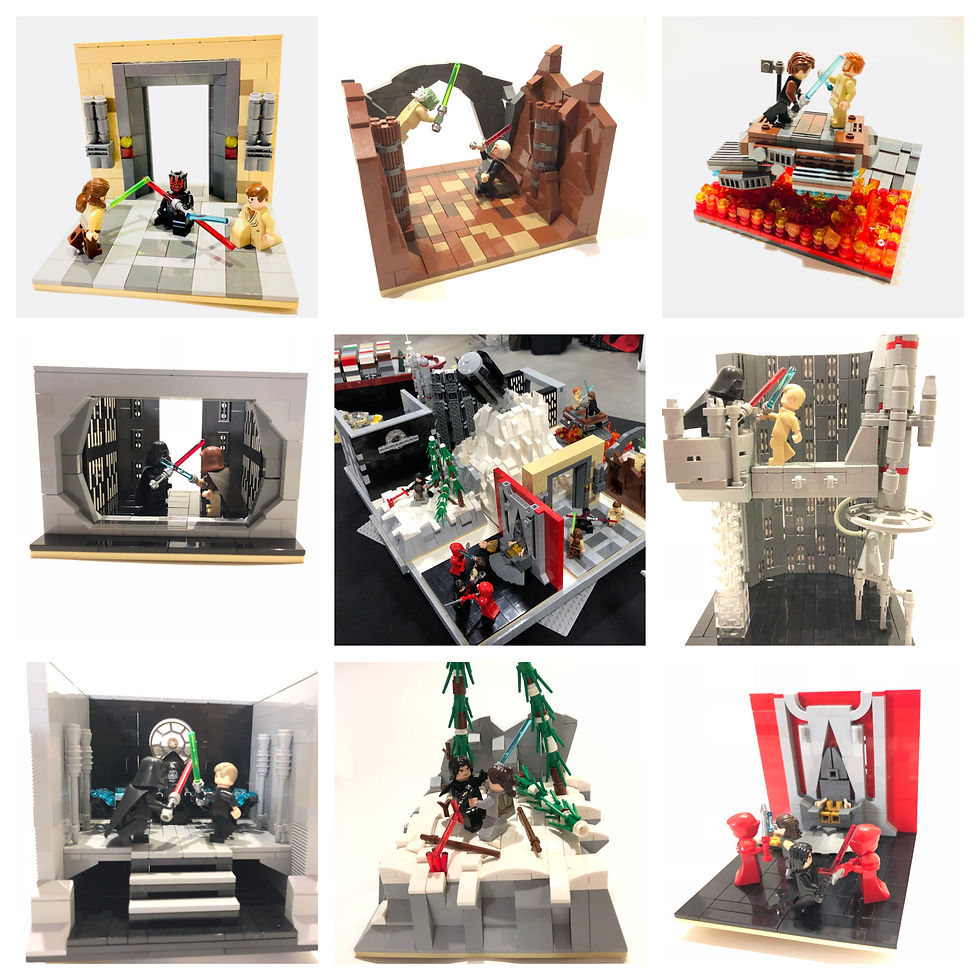
TWO BUILDS THAT CHANGED EVERYTHING
Is there a particular build you’re most proud of, or one that taught you something unexpected?
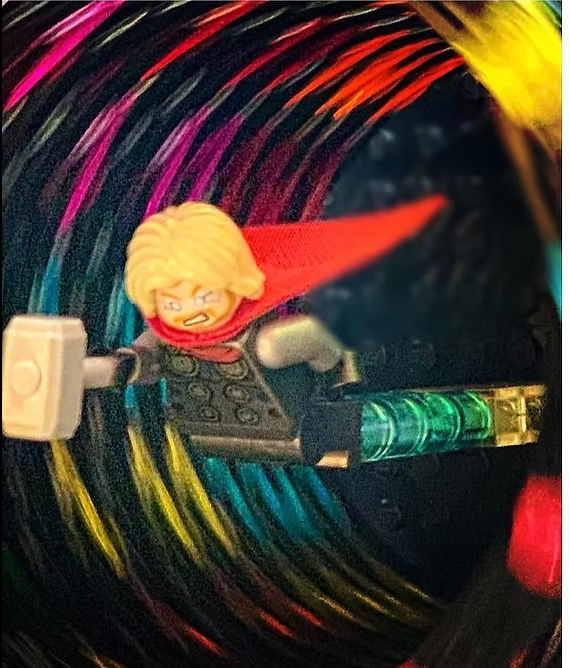
Thor and the Bifrost
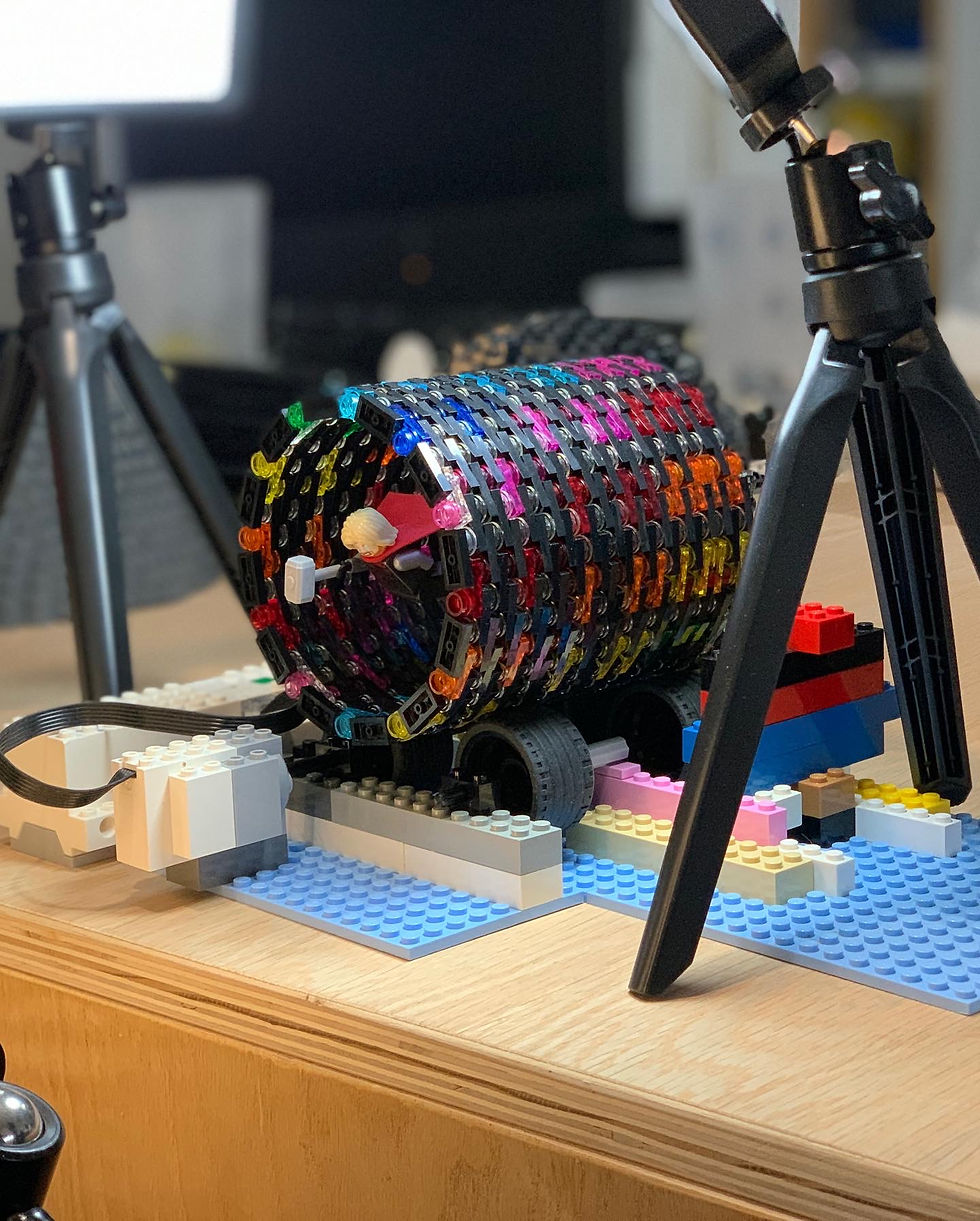
During a COVID-era online competition, the challenge was simple: create a build that captured motion in a single photo.With a nudge from his wife, Mounir engineered a rotating cylinder using LEGO gears—essentially a rock tumbler. He added lighting, placed a Thor minifigure inside, spun the mechanism, and snapped the shot.
The result?
A visceral, dynamic image that tied for first place and drew praise worldwide.
“As a MOC, it wouldn’t stand on its own. But as a concept? It worked beautifully.”

The Muppets CMF Stage
Asked to create a display for the LEGO Muppets minifigures, he designed a miniature stage—functional, charming, and immediately beloved.
“People kept asking for instructions. That really touched me. Families wanted my build in their homes.”
DISCOVERING COMMUNITY
How would you describe your experience in the broader LEGO community—both online and in person?
Lego truly became a lifestyle when I joined my local LUG. Surrounded by supportive, skilled builders, I found the mentorship, camaraderie, and inspiration i'd been craving.
During the pandemic, I joined the online SortLUG, giving me a global network of friends and collaborators. My first convention arrived much later—Brickworld Chicago 2024—followed by Bricks in the Six, where I would eventually meet the founder of BlackLUG, Wes Royer
“These events opened doors I didn’t even know existed,” he says.

IDENTITY, REPRESENTATION & THE RESPONSIBILITY OF STORY
If you’re comfortable sharing, how has your identity—including being a person of colour—shaped your experiences in the LEGO world?
As an Arab growing up in Canada in the ‘80s and ‘90s, being “the only one” in the room was familiar. Entering the LEGO world, he sometimes felt echoes of that same absence.
“I didn’t see other Arab builders. It wasn’t exclusion—it was visibility.”
In many immigrant families, hobbies like LEGO can be dismissed as childish or impractical. Mounir believes more culturally sensitive outreach could make a difference—especially in communities of colour where creative hobbies may not always be encouraged.
He appreciates LEGO’s expanding cultural catalogue—the Lunar New Year sets, Day of the Dead, La Catrina—but knows there’s still room for broader representation, especially of Arab and Middle Eastern cultures.
WHEN SOLIDARITY SPEAKS LOUDER THAN BRICKS
Have there been times when you felt particularly welcomed, seen, or supported within the community?
One moment of profound impact came at Brickworld Chicago. A non-Arab builder displayed the Palestinian flag alongside a poem by Refaat Alareer—despite facing harassment for doing so.
“That level of solidarity was humbling,” Mounir said it inspired him to display his own culturally rooted MOCs more openly, even in the face of criticism.
Event organizers stood by him through moments of backlash—a gesture he doesn’t take lightly.
“That support matters. It reminds me I have a responsibility to represent my heritage and give voice to my community.”
THE MYTH OF THE “EXPENSIVE HOBBY”
Are there any misconceptions people have about LEGO Stores, the AFOL community, or being a builder that you’d love to clear up?
One misconception Mounir is determined to challenge is the belief that LEGO is only for those with deep pockets.
“There are so many affordable entry points. Thrift stores. Used lots. Part drafts. LEGO pieces last decades.”
He encourages newcomers—especially younger builders—to start small, be patient, and build slowly.

THE FUTURE HE WANTS TO SEE
Are there themes, sets, or building opportunities you wish LEGO would develop in the future?
Looking ahead, Mounir hopes LEGO continues expanding its blend of creativity, diversity, and educational value. He’d love to see more crossover between LEGO Education products and the retail market, especially sets that empower parents to teach through play.
He also dreams of collaborations between LEGO Stores and Indigenous artists in Canada—something he has been thinking about for a while.
ADVICE TO NEW AFOLS, ESPECIALLY BUILDERS OF COLOUR
What advice would you give to newer fans—especially fans of colour—who are thinking about joining the AFOL community or sharing their creations publicly?
“Do it. And do it proudly.”
That’s the heart of his message. Be authentic. Don’t shrink. Don’t dilute. Don’t wait for permission.
“Your voice matters. Sign up for a convention as soon as you can. You’ll find allies.”
A COMMUNITY BUILT ON UNITY
What do you hope the LEGO community will look like in the next few years in terms of creativity, diversity, and collaboration?
Ultimately, Mounir hopes the LEGO community leans even further into openness, inclusivity, and cross-cultural creativity. He wants to see division dissolve—humorously adding, “I’m talking to you, Bionicle snobs!”
And above all, he hopes LEGO can be embraced as a medium for art, not just an extension of the brand.
“When artists use Perler beads to make political art, nobody tags the company in outrage. LEGO should be treated like any other artistic medium. I just want the freedom to express myself without jeopardizing my passion for the bricks.”
Mounir’s story sits at the intersection of memory, access, and intention. It reminds us that creativity is often shaped as much by what we didn’t have as by what we eventually discover. Through LEGO, he’s built more than models—he’s built a relationship with patience, process, and personal history.
At Blacklug, voices like Mounir Khoury matter because they expand the narrative of what the LEGO community looks like and who it holds space for. This conversation isn’t about spectacle or scale—it’s about presence, growth, and the quiet impact of building with purpose.
What follows after this interview isn’t an ending, but a continuation. Another story added to the archive. Another reminder that the most meaningful builds are often the ones that carry the most history.


Comments